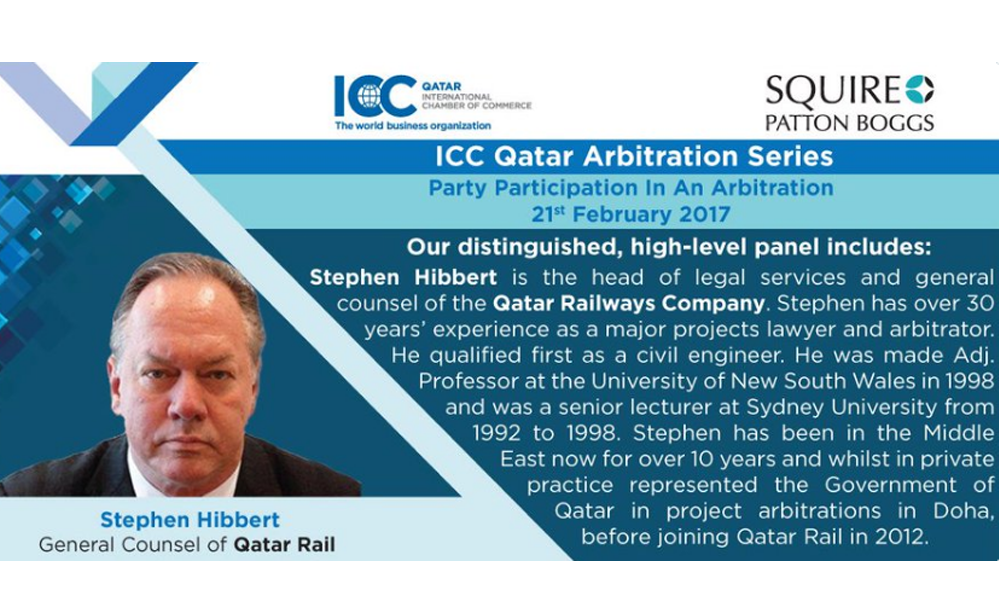
Adj. Professor Stephen A. Hibbert

Biju

Avatar

Reflections of a Major Projects’ General Counsel in the Middle East

After 8 plus years as the General Counsel and Head of Legal Services at the Qatar Railways Company in Doha, working to support that Doha Metro Rail project – 140km of underground track and 37 stations (31 of which were underground) – this article reflects on the lessons learned, and highlights the initiatives and actions that worked well and contributed to the project’s success. With first construction contracts awarded in June 2013, the project set new benchmarks for speed and safety, being put into full operation in 2019.

 In-house counsel in the Middle East, or those thinking of making the transition from private practice to in-house, might get value from the lessons learned and the techniques we used to prepare documents in both English and Arabic that were effective to read and understand.

Download Report

Read More

2021 CNN: Doha Metro: The gleaming metro system built under the desert

It’s fast. It’s driverless. It has a Gold Class for premium passengers. And it’s one of the most advanced metro train systems ever built.

This is the Doha Metro, a gleaming transportation system that will carry fans to their destination in next year’s soccer World Cup and, it’s hoped, will go on to revolutionize transport in Qatar.

Constructed mostly underground and across the Qatari capital and its suburbs, the network has been operational since 2019, providing a reliable transportation alternative in a rapidly expanding city where residents have long relied on cars and traffic is frequently gridlocked.

Phase one of the project saw the creation of 37 stations, with three lines — Red, Green and Gold — running along a 76-kilometer (47-mile) network. The fully automated, 60-meter-long trains have a 416-passenger capacity and are divided into three sections: Standard, Family (for lone females and males or females commuting with children aged 11 or younger) and Gold (Goldclub Travel Card holders) class.

Clean and spacious, the trains can cruise at up to 100 kilometers per hour (60 mph) and are fully equipped with CCTV and public Wi-Fi systems. They even have USB ports so that Gold class travelers can charge mobile phones and tablets while in transit.

Read More

Cyber risk: GCs take responsibility

Stephen Hibbert, GC of Qatar Rail, says that his role for monitoring and implementing cybersecurity has increased notably. “Qatar Rail was established in 2011,” he says, “and is considered a new industry in Qatar and the surrounding area.

Nevertheless, there is a potential risk for every business. Our technology record would show that in the last 18 months we’ve gone up another level of cyber protection. There has been a heightened awareness in our organisation and across government in Qatar.”

In the UAE, the Middle East-based GC adds: “General counsel here are seeing trends in how data subjects expect their data to be handled, and the direction of governance trends in their home countries – particularly if they are from the EU or North America. They’re trying to bring those strategic themes into the day to day operations of the businesses that they advise.” Beckett agrees: “Our clients have traditionally contacted us to help them address cyber crime, cyber enabled crime or leaks of information across the region. These days they are increasingly asking about cyber defence and for advice on preparing for GDPR compliance in relation to the data they hold on European operations or relating to European citizens.”

Read More

Dispute Resolution in Abu Dhabi ( Part 1): How can the System Possibly Cope?

April 9, 2010

On a first reading this might seem like a particularly narrow question. Perhaps geographically of limited utility.

But to almost every international organization in the industrial, defence and major projects sectors it is, in fact, one of the burning issues confronting their participation in a market planning to spend or invest $USD450billion in 2010.

In the current financial climate, the Middle East is the most real, immediate and accessible market for project and investment businesses, otherwise stymied in the economies of the USA and Europe.

The overall framework for this 4-part series will be first to briefly outline the current legal system that supports the region. To then to focus on the dispute resolution systems that are currently being used and to review their degree of success.

Some consideration will then need to be given to the recently (2007) introduced, bespoked, version of FIDIC ’99 for government work in Abu Dhabi and how that contract manages disputes. In that context, the role of a Dispute Administration Board is now mandated.

Finally, there needs to be made some observations on the relevant institutional body for commercial arbitration in Abu Dhabi – the Abu Dhabi Commercial Conciliation and Arbitration Centre (ADCCAC), and its procedures and objectives. That arbitration body is now also mandated in the Abu Dhabi government’s FIDIC versions.

It is difficult to convey to people who have never spent some time in the region, the strikingly inverse relationship here between size and wealth, and indeed population numbers.

The United Arab Emirates (UAE) is a federation of seven Emirates, nestled between Saudi Arabia and Oman and the waters of the Persian Gulf.

The geographical size of the UAE approximates to the State of Maine in the USA. Total population is between 5-6 million people. The state of Abu Dhabi (both a city and an Emirate) occupies ¾ of the UAE’s area and has a population of close to ( or pehaps now just exceeding) 2 million people. It is also the Federal capital of the UAE.

For 2010, the GDP of Abu Dhabi is expected to pass $USD450 billion of which near 70% will be spent in the construction (55%) and oil and gas (15%) sectors.

To put these figures into context, for Australia, with a population of 24 million and a workforce of 11.5million, the GDP for 2009 was estimated to be between $USD 900 billion and $USD950 billion. Abu Dhabi is planning to exceed that number by 2013-2014, and then double it again by 2020.

In an investment report by Isthmus Partners released 31st March 2010, Abu Dhabi is quoted as having 95% of the UAE’s oil reserve, and 92% of the proven gas reserves. The report says that, based on current utilization, Abu Dhabi’s oil reserves, will last for 150 years.

Abu Dhabi certainly has its share of distressed real estate developments and postponed major projects. But nowhere near the scale being experience in Dubai.

The focus of dispute resolution in the UAE has been, for much of 2009 and early 2010, entirely dominated by events in Dubai and the government entities, Dubai World and its development subsidiary Nakheel. And these were not issues limited, geographically, to the Gulf. The bond-financing instruments used in Dubai were once seen as grade “A” investments and were (and are today) held by the likes of RBS and HSBC, together with a plethora of institutions and individual worldwide.

But now, as the appetite returns for reinvestment in the Gulf, and the schedule for major projects in Abu Dhabi is reactivated, it is legitimate to ask – can the existing dispute resolution systems – especially Abu Dhabi – possibly cope? If there are doubts – what can be done? Or perhaps better – are there lessons to be learned from the Dubai experience and if so, what are they?

Against the statistics and figures quoted above, now add to them the fact that, presently, the Abu Dhabi court systems has pending before it approximately 320,000 cases. Many of those caes relate to employment and labour issues and a significant proportion relate to small comercial dipustes. But on any view, the court system of Abu Dhabi has little real capacity to manage major complex construction disputes.

And may I conclude this first part of the series by also noting that the UAE does not have an arbitration law. It does have, in the UAE’s Civil Procedure Law (1992), Articles 203 to 218 which specifically address arbitration, aspects of it’s the process and the enforcing of domestic awards. But, with respect, those provisions were not designed in anticipation of the current dimensions of doing business in the UAE in 2010.

I should note, for completeness, that it has been mentioned that the UAE soon will receive a new arbitration law, but a number of commentators feel that in the current circumstances, the finalization of a new arbitration law is just not seen as having sufficient priority.

In the next parts of this series – focusing on dipute resolution in Abu Dhabi – I will review in more detail the principle forms of contracts and arbitration agreements that are used in the Emirate and look more closely at some of the recent initiatives that the government has introduced to help manage issue resolution in the light of one of the world’s biggest building programmes.

Dispute Resolution in Abu Dhabi (Part 2) – Do We Have The Time, Or Luxury, To Rely Only On Arbitration As The Only “Alternative” in ADR?

April 14, 2010

Constructively, commercial arbitration is a judicially recognized and an enforced method of dispute resolution in the UAE.

Via Article 203 (5) of the Civil Procedure Law (1992), if the parties have agreed to refer a dispute to arbitration, an action on that dispute cannot be brought before the courts.

So let us assume for present purposes that the project in question, or the relevant commercial transaction, does have an arbitration agreement in it, which is recognized by the courts and enforced.

In many ways arbitrating major disputes in the UAE can be a far more complex process than in, say, the USA or UK or Europe.

First, what needs to be understood is that the list of criticism and “adverse” features in modern comercial arbitration, enumerated by Thomas Stipanowich recently in his paper “Arbitration: The New Litigation” (Univ. Illinois Law Review 2010) are all present and accounted for in the UAE. But in the UAE their mix and relative weightings differ.

300 plus years of common law litigation process in both the USA and UK has produced such a detailed set of procedures for litigation, that their almost complete adoption into many major arbitrations, has done arbitration a great dis-service.

In these Western countries, the Medieval processing of the merchants ( the “sniff & smell” arbitrations) have now been replaced by processes quoted by Thomas as being similar to civil litigation – judicialized; formal; costly and time consuming.

We all know what the elements are, in the arbitration process, that lend themselves to this criticism. They include discovery (especially nowadays “e” discovery); accessing 3rd party documents; prehearing procedures; factual and expert reports (for both claimant and respondent); a “hearing” process of some form, including possibly oral testimony and cross- examination.

Next, and quite critically, once an award is delivered while there needs to be a clear pathway to enforcement, in some jurisdictions the relevant arbitation law will permit appeals – allowing time to run on and further costs to be incurred. It is unfair to generalise too much as there are, of course, many examples of successful arbitations. But let us accept for present purposes that in the Gulf most arbitrations over significant sums of money or complex technical issues do involve these traditionally “litigious” style of steps and processes.

Now consider a scenario under which the concept of “judicialized” did not, in effect, exist.

“Judicialized” can of course mean many things, but to western lawyers it is, perhaps, the briefest way of starting with “due process” ; moving though “natural justice and fairness” ; touching upon the independence of experts and the arbitrator(s); having the abitlity to verify facts, and ending with a comprehensive, detailed, judgment, with reasons.

Accordingly, a fair deal of the debate on arbitration reform, especially in the USA and UK has been framed on the baisis of a comparative analysis with the processes in the respective court systems. But what if, in the country of your arbitration, there were not so similar court processes? What would then be the “meates and bounds” of the arbitration debate? I would suggest far less clear and far more open to argument on the fundamentals.

The UAE is a civil law system, but one that has developed in very recent years, comparatively to the USA; UK and Europe. The Federation was only formed in 1972 and the UAE Civil Code first promulgated in 1985. A Commercial Code followed in 1993, a year after the Civil Procedures law.

The court system in the UAE copes with technical or complex construction matters by essentially referring the issues out to court appointed “experts” . In construction matters, those experts are generally engineers fluent in Arabic. The expert will submit his report to the court and the court will decide whether to adopt it or, if the findings are contested, then the court might be persuaded to refer the matter to another expert. This whole process can take 30-60 days and be entirely based on the materials submitted by both parties. Rarely, if at all, is there a hearing with oral testimony in civil cases. Accordingly, there has not been and indeed there cannot really ever be a “judicialisation” of arbitration in the UAE – if by that term we mean the processes of civil litigation in western common law and civil law systems. Accordinly, in the UAE, the responsibilities that then devolve to the relevant arbitration body and arbitrator(s) are, in my view, far more significant than in Western countries.

Put another way, for disputes arising from major projects , or complex commercial transactions , the pressure on the arbitration process to get it right and to deliver an outcome that is just, fair and within an acceptable time frame, is probably no greater anywhere than in the UAE at present – given the sheer size of the UAE’s build and investment programme.

And that is not at all to say that the arbitration institutions in the region have not risen to the challenge. They have, and continue to do so. But the sheer size and volume (and complexity) of many of the disputes in the region have never really had to be addressed by such a small artibration community.

Finally , what the GFC has thrown up in the Gulf, in the context of dispute resolution, is the role and legitimate interests of the finance/banking sector and investors. Unfortunately, the “system” in the UAE has had difficulty coping with the combination of insolvent developers; defaulting purchasers and defacto “mortgagees in possession”.

Add to that the fact that most of the building contracts and real estate sale and purchase agreements included arbitration clauses, and for some developmetns there are literally 100s of disgruntled purchasers who have to initiate individual arbitrations to try to either get their deposits and partial payments back, or to seek some form of remedy.

The challenge therefore, particulary in Abu Dhabi, for the legal profession and for the government seeking to secqure international investment, is to design and implement dispute resolution processes that recognize the relaties and limitations of the underlying court system(s) and respond to the demands for investor certainty and enforceable outcomes.

Dispute Resolution in Abu Dhabi (Part 3) – A Lot Now Rides on Success of the DAB System

April 22, 2010

The most commonly used form of construction contract in the Gulf is the FIDIC form. Although the FIDIC forms, for project procurement and consultantcy services, progressed slowly over the years, culminating in the burst of colours in the suite of contracts issued in 1999, some parts of the Middle East still use the 1987 (Red Book) version. Indeed, most government contracts in Oman are based on the 1981 version of the Red Book, updated marginally in clause 67.

In Abu Dhabi, some years ago, a decision was made by the government here to prepare, under license from FIDIC, two bespoked forms of the contract – build only, and design and build. Those forms were issued in 2007 accompanied by the requirement that they be used as the form of contract by all government departments in the Emirate of Abu Dhabi.

The centrepiece of the ADR process in that new form of contract is the use of a Dispute Adjudication Board (DAB).

It is not the purpose of this note to review the quite lengthy and detailed DAB and related dispute resolution procedures set out in the contract.

What is perhaps more relevant for the theme of this 4-part commentary, focusing on ADR in the Abu Dhabi major projects market, is the fact that, via this mandated form of FIDIC, the dispute resolution process proceeds first to the DAB(cl20.4) ie the use of a DAB is now the default rather than, in earlier versions, an option.

The Abu Dhabi government’s version of the FIDIC contract does maintain cl20.5 which expressly encourages amicable settlement at any time.

Finally, if those two processes do not resolve the matter, the dispute is referred to “final and binding” arbitration. The default body and rules are those of the Abu Dhabi Commercial Conciliation and Arbitration Centre (ADCCAC).

In theory, of course, it is possible for some of these provisions to be amended by a government authority for a specific project. But what is more relevant for this note, is that after a detailed review and consultation process, the decision was made to mandate a DAB.

I see the introduction of a DAB as a very valuable and important step to facilitate major project disputes in Abu Dhabi.

In theory, a project-specific DAB, properly appointed and constantly in touch with a project’s progress and the development of a dispute, seems like not just a good solution, but an almost “ must have” for the demands created by projects in Abu Dhabi in 2010 and onwards.

But as good as they appear to be in theory, DABs seem to have a chequered history and more of a “B” rating, than an A+ in construction disputes.

Perhaps their fate is not helped by the entry alongside “dispute board” in Wikipedia which says “This article is an orphan, as few or no other articles link to it”.

But that is being a little unfair. In many jurisdictions DABs compete with an array of offerrings from commercial ADR institutions, advancing soltionsthat are quite varied and not limited to just arbitration (see for example AAA’s and the ICC’s extensive menus of ADR solutions).

So what are, or should be, the drivers in the Abu Dhabi market for making this DAB process work?

First, speed to an initial decision. Around the world, and particularly with in-house counsel, the constant and resounding criticism of arbitration is that it takes too long, and is too appealable (ie even longer). In almost all surveys of arbitration users, time and delay ranks far more significantly than cost. The case for arbitration, for major project and construction disputes, is not helped these days as being almost always a very expensive process. But speed of decision consitently comes first in surveys of in-house counsel and the users of the ADR systems, as the key factor in choosing an ADR solution or in measuring its success or valueto them.

Consistently with the views of Tom Stipanowich (Arbitration: the New Litigation(Univ. Illinois Law Review 2010) a speedy process must, by its very nature, require the setting of tight boundaries on evidence and submissions and expert reports. And the surveys tend to indicate that a controlled, and ostensibly fair but speedy system, is what most large orgainaistions are looking for thesedays.

Witness the outstanding success of the adjudication system in England. In England, and in Australia where it has been almost uniformly adopted in all states, it has had the effect of greatly reducing the number of disputes that go to arbitration. Adjudication has, however, had some adverse side effets. It has produced a large number of court cases at the stage the court is asked to adopt the adjudicator’s report. In the first 4 years of its introduction in Australia, there were over 150 cases ranging from issues of statutory interpreation through to whether the adjudicator had exceeded his jusrisdiction. The outcome being that a relatively short statute needs to be read an interperted in the light of quite a number of important judicial pronouncements. Another side-effect is that lawyers running these matters regularly have to prepare in 14 or 28 days claims and evidence that otherwise would take many months in an arbtiration or even in court.

So will the use of a DAB in Abu Dhabi produce a better result than say arbitration? Or is there a better alternative in this region and at this time in the cycle of major projects?

On any view the introduction of a mandated DAB is a very good first step. The essence of an effective DAB is a decision making process, in real time, by people who can see and view the project and fully understand the issues.

It is the complete converse of a project-specific DAB, that years after construction is completed 3 learned arbitrators have a sitting lasting mouths, to hear and consider expert debate on what did happen and more theoretically, what should have happened or been done, as they look at “as-built” programmes and the true audited accounts of the builder (did he really suffer a loss?).

If you therefore set the sceneas being Abu Dhabi in 2010 and onwards, looking to attract and secure investment; seeking to give transparency to the dispute resolution process and both physically and commercially just purely manage the massive volume of work (and hence disputes) there can be no argument against doing everything that is sensibly possible to make the DAB system work.

One real concern I have is that this initiative is not backed by my professional collegues, or their clients, in Abu Dhabi. If that were to happen, I do not believe that the “system” absent a DAB process, will cope at all.

Finally, let us not forget mediation. In the final part of this series I would like to advance the case for both ad-hoc and institutional mediation to be used as a first choice even before DAB’s in the major project market in Abu Dhabi.

It is not by chance that ADCCAC’s title includes the term “ concilitation” and that the centre promotes a disputes clause that requires the parties first to attempt concilitation, before embarking on an arbitration. In the next part I will review in some detail ADCCAC’s approach to conciliation and how it might be a valuable process for this market, at this time.


Dispute Resolution in Abu Dhabi (Part IV): Is Conciliation Before Arbitration the Answer?

April 29, 2010

It was a deliberate decision of the Abu Dhabi Commercial Conciliation and Arbitration Centre (ADCCAC) to include both the term and procedures for “conciliation” in their rules.

Representatives of ADCCAC regularly comment to the effect that they see it as one function of a dispute resolution body to offer to the disputants a pre – arbitration solution, via a speeder and less formal set of procedures. Consistently with that theme, ADCCA has in it’s rules a detailed set of provisions that relate to the concilation of a dispute – before arbitration. Below, in summary, are some features of ADCCAC’s approach, certain of which are quite distinctive.

First, like all ADR provisions, the jurisdiction of ADCCAC’s conciliation process starts with either a disputes clause that includes conciliation as a first step, or by way of a joint, ad hoc, reference from the parties.
ADCCAC’s conciliation procedures then outline, or make provision for, the the particulars of the dispute, and supporting documents, to be provided to the Centre by the claimant and a reply by the respondent.

At that point a Conciliation Board is formed. Again, members of the Board can be agreed between the parties, but if there is no agreement, the Centre will select the Board members.

Next, the Board sits and hears from each party claim, it’s and counterclaims. ADCCAC’s particular procedures require the Board to produce a written summary of the case and that summary, or minutes (as they are termed), must be signed by both parties.

Under ADCCAC’s conciliation rules, the Board can reconvene with the parties, or require further information, as it deliberates on the matters in issue. The Board then produces a written report; delivers it to the parties and then reconvenes to hear the reaction of the parties to the report.

There are then in place (in the rules) a set of procedures by which the Board, and the parties, use the report as a from of, if you like, agenda or reference point to see if the dispute can be resolved. Resolution comes in the form of a version of the report ( an iteration at any stage) being accepted by both parties.

As is usual, ADCCA’s conciliation rules cloak the process in confidentiality and protect any evidence or admissions from future use in arbitration or litigation.

Some might see that this concilation process has borrowed a little from both structured negotiations and mediation. But leaving aside labels, it does have the somewhat unique feature of a report being produced for the consideration of the parties and then used as a tool to represent both progress in negotiations, and, if successful, a settlement.

For western lawyers, there may be some initial hesitation in engaging in a process close to mediation, but where a wirtten report is produced by the tribunal.

I suspect that many readers who are practitioners of ADR solutions on major projects, might also possibly baulk at the degee of formality (i.e. the production of a report by the Board) in ADCCA’s Conciliation procedures. But in a region where Arabic is the national language, and English is permitted and used in commerce, but generally via a side-by-side translation, it is more common than not that there be clear documentation at each stage in the ADR process. For arbitrations, ADCCA provides a case managed approach and indeed a very “hands on” style of management.

For it’s conciliation model, ADCCA’s procedures are more focused on ensuring that the parties understand each stage, and ackowledge perhaps any concessions or partial agreements on facts or figures that have been reached.

Concluding this part of the 4 part series, it can fairly be observed that, in the UAE, and in Abu Dhabi in particular, all industry participants – especially their legal advisors – need to support the use of Dispute Adjudiction Boards (in the FIDIC Abu Dhabi Governement form) and further should refer to and include ADCCA’s conciliation process in the dispute resolution clauses in contratcs for major projects, or, indeed, even in significant commecial transactions.

There is a real risk that if these techniques of ADR are not supported, the region will not be able to attract the inflow of foreign investment, which it is now is critically dependent upon.